NAD+ Protocols Explained: The Missing Link to Better Energy and Longevity
What 4 Leading Doctors Actually Take

You know that feeling when you used to bounce back from a late night, and now you need three days and an IV drip? Or when “just tired” became your default personality trait? Welcome to NAD+ decline—the cellular aging process nobody warned you about.
By the time you hit 40, you’ve lost half the NAD+ you had at 20. By 60? You’re running on fumes. NAD+ (nicotinamide adenine dinucleotide) is actually a coenzyme that powers literally everything—your energy, your brain, your ability to repair damage at the cellular level. And it’s quietly disappearing.
The supplement industry wants you to believe the answer is a $200/month stack of pills. Wellness influencers are pushing their affiliate codes. But here’s what the actual experts agree on: your lifestyle habits might matter more than any pill.
This matters because NAD+ is critical for:
Converting food into cellular energy (ATP)
Repairing DNA damage (up to 70 breaks per minute per cell)
Activating sirtuins, the longevity proteins
Fighting oxidative stress
Without adequate NAD+, your cells simply can’t maintain themselves. It’s why older people get sicker faster, recover slower, and have less energy
Approach #1: High-Dose NMN + CD38 Blockers
The popular biohacking protocol is aggressive:
900mg of NMN daily (3-4x the typical dose) or NAD+ IV infusions
Apigenin to block CD38
Resveratrol to further inhibit CD38
The reasoning? An enzyme called CD38 destroys both NAD+ and NMN. As you age, CD38 activity skyrockets due to chronic inflammation (often from leaky gut). Taking NMN without blocking CD38 is like filling a bathtub with a hole in it—you’re fighting a losing battle.
The cost: $100-200+ per month.
Approach #2: Niacinamide + Fix the Root Cause
Dr. Nicola Conlon, who worked in drug development for aging, takes a completely different view. She argues that the entire NMN industry is missing the point.
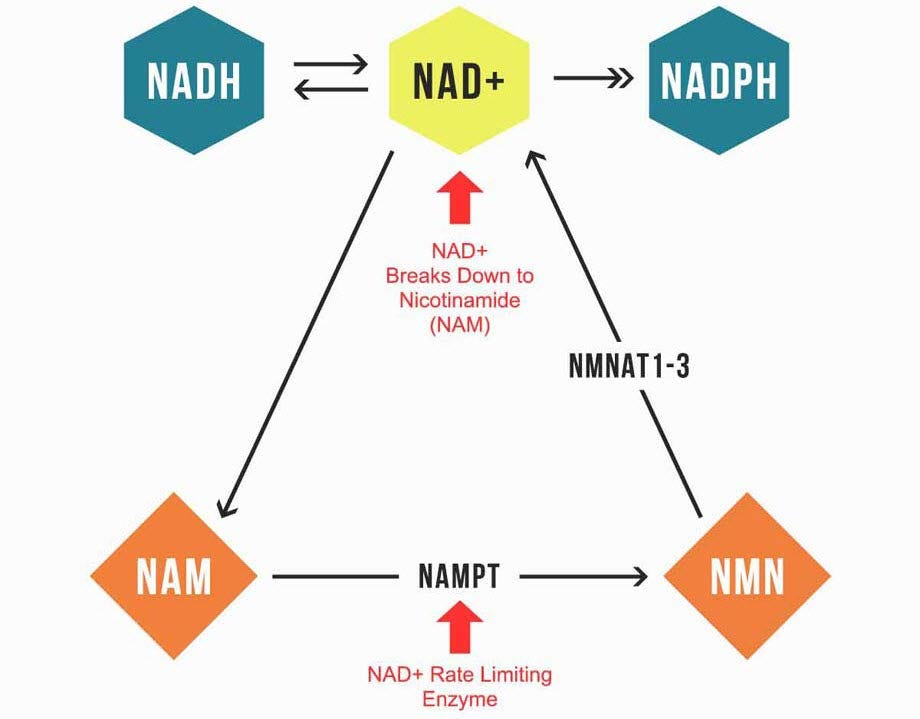
Here’s why: When NAD+ gets used up in your cells, it breaks down into niacinamide. Your body has a “salvage pathway” that’s supposed to recycle this niacinamide right back into fresh NAD+. The key enzyme in this pathway is called NAMPT.
The problem isn’t that you lack raw materials. The problem is that NAMPT activity drops 50% between ages 45 and 60.
According to Conlon, flooding your system with NMN doesn’t address this bottleneck. It’s like trying to speed up a factory by dumping more raw materials on the loading dock when the real issue is that the machinery inside is broken.
Her solution? 25-50mg of niacinamide three times daily. Why niacinamide specifically?
It’s the immediate breakdown product of NAD+
It directly feeds into the salvage pathway
At low doses, it doesn’t inhibit sirtuins (high doses do, which is bad)
It costs less than a penny a day
The cost: About $11 for a four-year supply.
Approach #3: Dr. Kaufmann’s Pragmatic Middle Ground
Dr. Sandra Kaufmann, Chief of Pediatric Anesthesia and author of “The Kaufmann Protocol,” takes a refreshingly honest stance: she doesn’t know which precursor is definitively better, and neither does anyone else.
Her protocol:
250-500mg of Nicotinamide Riboside (NR) daily
Combined with a multi-targeted approach including resveratrol, pterostilbene, astaxanthin, curcumin, and carnosine
When asked about NMN vs. NR, she’s candid: “You can either get the NAD from NR or NMN—I really don’t think it makes a difference. There’s never been any head-to-head testing... I think this is a war of companies because they both have their trademark compounds.”
Her bottom line? “Taking one of them, I think is crucial.”
But she doesn’t stop at just NAD+ precursors. Her comprehensive protocol addresses multiple aging pathways simultaneously—metabolic support, DNA repair, antioxidant defense, and inflammation control.
The cost: Moderate—roughly $30-60 per month depending on product quality.
Approach #4: Dr. Mark Hyman’s Functional Medicine Framework
Dr. Mark Hyman, board president for clinical affairs at The Institute for Functional Medicine and author of “Young Forever,” brings a systems-based perspective that asks: what’s causing the causes of aging?
His approach:
NMN for NAD+ support (takes it daily in his personal stack)
Urolithin A from pomegranate (improves autophagy, VO2 max, and muscle function)
Creatine with regeneratively-raised goat whey for muscle building
Root cause focus: addressing food quality, environmental toxins, and systemic inflammation
What makes Hyman’s framework distinct is his insistence on going upstream. If NAD+ decline is the problem, what causes the decline? Mitochondrial dysfunction. What causes that? Poor diet, toxins, stress, inflammation. What causes those? The food system, environmental factors, lifestyle.
His biological age is 43 despite being 63 chronologically—a 20-year difference he attributes to decades of consistent healthy living, resistance training, and nutrigenomics (using food to influence gene expression).
Hyman emphasizes that 70-80% of your plate should be vegetables, nuts, seeds, and fruit—packed with polyphenols that activate longevity pathways and support the gut microbiome. He tracks blood sugar with a continuous glucose monitor and follows time-restricted eating (stops eating 3 hours before bed to allow insulin and glucose to normalize).
His take on NAD+: “I take NAD+ on a daily basis along with a few other vitamins, a healthy diet, and movement to fully support my mitochondrial production.” For Hyman, NAD+ supplementation is one tool in a comprehensive toolkit—not a standalone solution.
The cost: Moderate to high—$50-100+ per month for supplements, plus focus on high-quality whole foods.

The Lifestyle Factor They All Agree On
Here’s where it gets interesting: every approach acknowledges that supplementation alone isn’t enough.
To truly restore NAD+, you need to activate NAMPT naturally through:
Resistance training (increases NAMPT by 127% in three weeks)
Fasting or time-restricted eating (activates AMPK, which boosts NAMPT)
Heat stress (sauna bathing)
Circadian rhythm optimization (NAD+ is naturally cyclical)
Outdoor time and reduced EMF exposure (more on this below)
Gut health (reduces the inflammation that drives CD38 activity)
Dr. Mercola, at nearly 70, claims his NAD+ levels are those of someone much younger because he does an 18-hour daily fast, resistance training, and 20 minutes in a 160°F sauna—all while taking just 50mg of niacinamide.
The Hidden NAD+ Killer: Why You Need to Get Outside
Here’s something most NAD+ protocols completely miss: your indoor lifestyle is quietly destroying your NAD+ reserves.
Every time you’re exposed to electromagnetic fields from your phone, WiFi router, or laptop, you’re creating DNA damage. And every instance of DNA damage activates an enzyme called PARP1, which consumes about 150 NAD+ molecules per activation to repair the damage.
Studies show that extensive DNA damage in a cell can deplete NAD+ levels to just 5-10% of baseline within five minutes. This PARP-dependent NAD+ depletion happens on a cellular level throughout your body, constantly draining your reserves.
The solution? Get outside. Take weekend getaways. Go on long nature walks. Hike. Camp. Spend entire days away from WiFi and screens. When you’re outdoors—away from the constant EMF barrage of modern life—you’re giving your cells a break from this relentless DNA damage. Less damage means less repair needed, which means PARP1 isn’t constantly burning through your NAD+.
The compound effect: Less indoor time → Less EMF exposure → Less DNA damage → Less PARP activation → More NAD+ preserved. Plus: More morning outdoor light → Stronger circadian rhythm → Better NAD+ cycling → Better sleep → Less inflammation → Less CD38 → More NAD+ preserved

So What Do We Know?
Human clinical trials with NMN and NR haven’t replicated the dramatic results seen in animal studies. Conlon suspects this is because precursors don’t address root causes—the declining salvage pathway and excessive CD38 activity.
But the high-dose NMN plus CD38 inhibitor approach hasn’t been rigorously tested in controlled trials either.
And Kaufmann’s honest admission—”I really don’t know which is better”—might be the most scientifically accurate position of all.
What we do know:
NAD+ testing is unreliable (the molecule degrades within minutes outside the body)
The salvage pathway decline is real and well-documented
CD38 does waste massive amounts of NAD+
NAMPT is definitively the rate-limiting enzyme
Lifestyle factors can boost NAMPT more than any supplement
Consistency matters more than picking the “perfect” precursor
The Practical Takeaway
If you’re on a budget: Start with niacinamide (25-50mg three times daily), focus intensely on lifestyle factors (fasting, resistance training, sauna, gut health), and see how you feel after 2-3 months. Track your energy, mental clarity, and sleep quality.
If you want the middle ground: Follow Dr. Kaufmann’s approach with 250-500mg of NR daily, add synergistic compounds like resveratrol and curcumin, but don’t neglect the lifestyle foundation. This balances cost with the comfort of using well-studied compounds.
If money isn’t an issue: Try the high-dose NMN approach (900mg) with CD38 inhibitors, but understand you’re essentially running your own experiment. Without fixing inflammation and activating NAMPT naturally through lifestyle, you’re still treating symptoms.
The universal truth: Regardless of which precursor you choose, the real anti-aging work happens in your daily habits—when you eat, how you move, how you sleep, and how you manage stress.
Your cells are constantly recycling NAD+ right now. The question isn’t whether to supplement—it’s whether you’re giving your body what it needs to do the job itself. And on that point, every expert agrees: lift heavy things, don’t eat all day, get hot regularly, fix your gut, and be consistent.
Everything else is just details we’re still figuring out.